Most perfume fades by lunch because most perfume is diluted to fade by lunch — Eau de Toilette, the concentration behind the majority of mass-market bottles, is only 5–15% fragrance oil, which physically cannot outlast a full day on skin.
It's not your skin chemistry
"My skin just eats perfume" is one of the most repeated myths in fragrance. Skin chemistry does shift how a scent smells slightly from person to person — pH, natural oil levels, and diet can all nudge a scent's character — but it doesn't explain a fragrance vanishing in two hours. Concentration does. Pour less oil into the bottle, and there's simply less scent molecule left to evaporate off your skin over the course of a day, regardless of whose skin it's on.
What 25–30% actually changes
Extrait de Parfum concentration — 25–30% fragrance oil — isn't a marginal upgrade over EDT or EDP, it's a different experience entirely. At that concentration, a scent doesn't just last longer, it also projects differently: a warm sillage (the trail a scent leaves) that holds through a work day and straight into the evening, instead of needing a midday reapplication that most people just don't carry around with them. The dry-down — how a fragrance smells hours after application, once the lightest top notes have burned off — is also far more pronounced at Extrait strength, because there's simply more of the deeper base notes left to smell by that point.
The reapplication trap
Because EDT fades fast, a lot of people assume the fix is just reapplying more often. In practice, this rarely works the way people expect — carrying a bottle around isn't realistic for most days, and reapplying on top of already-faded fragrance can create an uneven, patchy scent experience rather than a consistent one. The better fix isn't more frequent application of a low-concentration formula; it's starting with a concentration that doesn't need it in the first place.
Why this feels like a recent problem
Fragrance houses have leaned harder into EDT and lighter EDP formats over the last few decades, partly because they're cheaper to produce at scale and partly because lighter scents are seen as more "versatile" for office environments with fragrance-sensitivity norms. The side effect is that an entire generation of fragrance buyers has mostly only ever experienced lighter concentrations, which is part of why Extrait strength can feel surprising the first time someone actually wears it — it's not a new technology, it's an older standard that's become less common on store shelves.
The marketing language problem
Terms like "long-lasting," "intense," or "24-hour fragrance" appear on packaging across every price point, regardless of actual concentration — these are marketing claims, not formulation facts, and they carry no legal definition the way EDT/EDP/Extrait do. A bottle can call itself long-lasting while still being a 10% dilution; the only way to verify the claim is to check the concentration term itself, or run the single-spray test and see what's left by evening.
Why a fading scent isn't necessarily a bad fragrance
It's worth separating two different problems: a scent that fades fast, and a scent that's poorly made. Plenty of well-formulated EDTs smell genuinely good — they're simply built on a lighter dilution by design, often intentionally, for a specific lighter-wear use case like a quick refresh rather than all-day coverage. The issue isn't that EDT is a bad format; it's that it gets marketed and purchased as if it performs like something it isn't.
How to actually test this yourself
Spray once, at 9am, and don't touch it again. If you can still smell it faintly on your wrist at 6pm without reapplying, you're wearing something built at Extrait strength. If it's gone by 1pm, check the label — it's almost certainly an EDT. This simple test cuts through marketing language faster than any product description, because performance at hour eight is impossible to fake with dilution alone.
Why this matters more in a hot climate
Heat speeds up evaporation, which means an already-light EDT fades even faster in warm weather than the numbers above suggest. This is one of the reasons higher concentration matters even more in a climate like India's, where lighter formulas are working against both their own dilution and the weather at the same time.
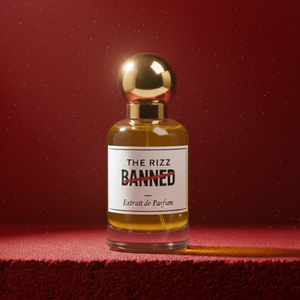
Every scent in The Rizz Club's lineup is built at 25–30% Extrait de Parfum specifically so you never have to think about reapplication — from Banned's pear-and-black-vanilla trail to Oud Supreme's smoky depth. Curious what the difference actually feels like on skin? Read EDT vs EDP vs Extrait, or see exactly how long you should expect a real Extrait to last in our honest longevity guide.
Quick answer
Perfume that fades by lunch isn't a skin problem — it's almost always a 5–15% EDT doing exactly what a 5–15% EDT is built to do. A 25–30% Extrait is built for the opposite, and no amount of reapplying a light formula fully closes that gap.